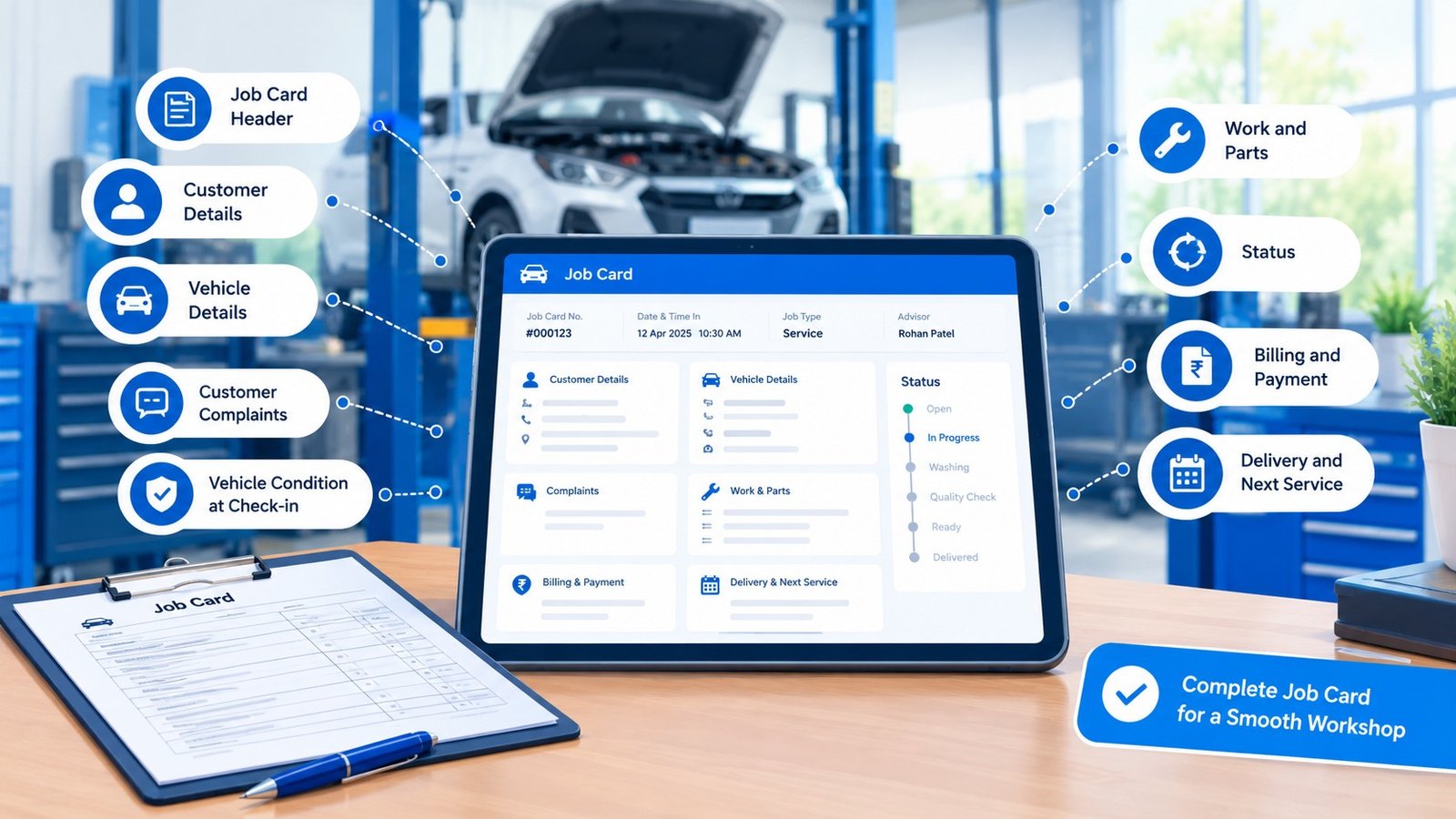
What Should a Vehicle Job Card Contain? A Checklist for Workshops
A good job card protects you and your customer. Use this checklist to make sure your job card format, on paper or digital, captures everything from check-in to delivery.
A job card is more than a work order. When a customer disputes a bill or says "this scratch wasn't there before", the job card is your record. Here is what a complete vehicle job card should contain, section by section. Use it to check your current format, whether you use a printed book or software.
1. Job card header
Job card number: unique and in sequence, so no job is lost or duplicated.
Service advisor or staff name: who received the vehicle.
2. Customer details
Customer name and mobile number (WhatsApp number if different).
Address, and GSTIN if the customer wants a business invoice.
3. Vehicle details
Registration number.
Make, model and variant; fuel type.
Odometer reading (km): needed for the next service and for warranty claims.
Chassis or engine number for insurance and warranty jobs.
Insurance company and policy end date, if you want to remind the customer before renewal.
4. Customer complaints
Write complaints in the customer's own words, one per line: "noise from front left wheel when braking", not just "brake work". It avoids arguments later about what was asked for.
5. Vehicle condition at check-in
Existing dents, scratches and broken parts.
Fuel level and valuables left in the vehicle.
Photos: four sides plus close-ups of any damage. Photos settle disputes faster than any written note.
6. Work and parts
Each labour item with its charge.
Each spare part with quantity, rate, discount and HSN code, which you need for GST.
The technician who did the work.
Any extra work found during service, and a note that the customer approved it before you did it.
7. Status
Track where the vehicle is: open, in progress, washing, quality check, ready, delivered. Customers who call asking "is my car ready?" can get an answer in seconds.
8. Billing and payment
Subtotal, discount, GST (CGST and SGST) and grand total.
Next service due date and kilometres: print it on the bill so the customer knows when to come back.
Printable checklist
Section
Must have
Header
Job card no., date/time in, job type
Customer
Name, mobile, GSTIN if needed
Vehicle
Reg. no., model, odometer km
Complaints
In the customer's words
Condition
Damage notes and photos
Work
Labour, parts with HSN, technician
Bill
GST, total, paid, due
Delivery
Date, next service date and km
Using a digital job card
In Autojobcard's digital job card, most of this fills in by itself. A returning vehicle brings its customer and vehicle details, the job card number is generated, and GST is calculated from each part's HSN code and rate. When a periodic service is delivered, the next service date and kilometres are set automatically. Try it free on your next vehicle.