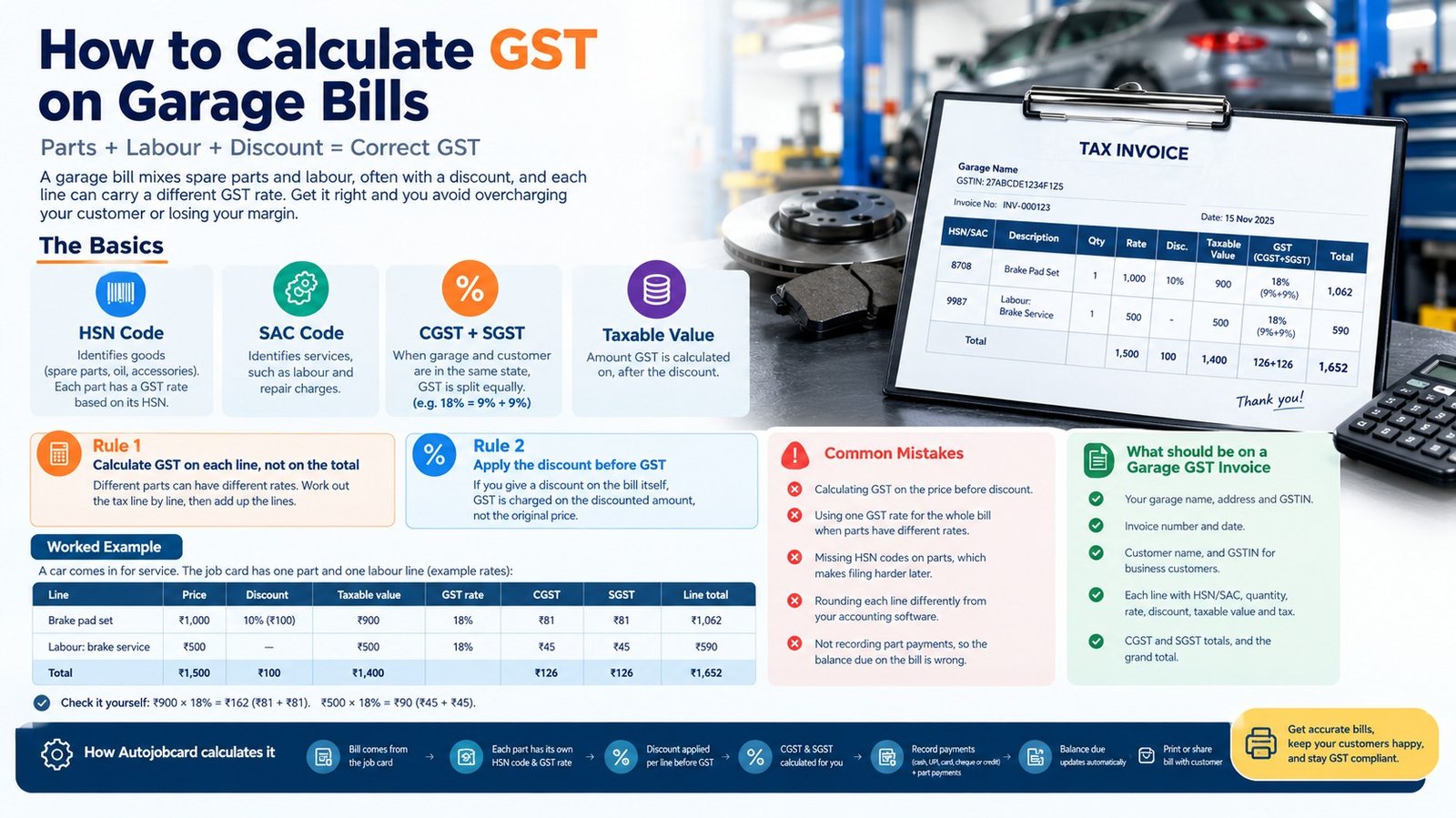
GST Billing for Garages: How Parts, Labour and Discounts Are Calculated
GST on a garage bill confuses a lot of workshop owners. This guide walks through how parts and labour are taxed line by line, with a worked example you can check on a calculator.
A garage bill mixes spare parts and labour, often with a discount, and each line can carry a different GST rate. Get it wrong and you either overcharge the customer or pay the tax out of your own margin. This guide explains how the calculation works, line by line, with an example.
Note: GST rates change from time to time and depend on the HSN or SAC code. Always confirm current rates on the official GST portal or with your CA. The rates in the example below are only for illustration.
The basics
HSN code: identifies the goods (spare parts, oil, accessories). Each part has a GST rate based on its HSN.
SAC code: identifies services, such as labour and repair charges.
CGST + SGST: when your garage and the customer are in the same state, GST is split equally between central and state tax. For example, 18% GST = 9% CGST + 9% SGST.
Taxable value: the amount GST is calculated on, after the discount.
Rule 1: Calculate GST on each line, not on the total
Different parts can have different rates. Work out the tax line by line, then add up the lines.
Rule 2: Apply the discount before GST
If you give a discount on the bill itself, GST is charged on the discounted amount, not the original price.
Worked example
A car comes in for service. The job card has one part and one labour line (example rates):
Line
Price
Discount
Taxable value
GST rate
CGST
SGST
Line total
Brake pad set
₹1,000
10% (₹100)
₹900
18%
₹81
₹81
₹1,062
Labour: brake service
₹500
—
₹500
18%
₹45
₹45
₹590
Total
₹1,500
₹100
₹1,400
₹126
₹126
₹1,652
Check it yourself: ₹900 × 18% = ₹162, split into ₹81 CGST and ₹81 SGST. ₹500 × 18% = ₹90, split into ₹45 + ₹45.
Common mistakes
Calculating GST on the price before discount.
Using one GST rate for the whole bill when parts have different rates.
Missing HSN codes on parts, which makes filing harder later.
Rounding each line differently from your accounting software.
Not recording part payments, so the balance due on the bill is wrong.
What should be on a garage GST invoice
Your garage name, address and GSTIN.
Invoice number and date.
Customer name, and GSTIN for business customers.
Each line with HSN/SAC, quantity, rate, discount, taxable value and tax.
CGST and SGST totals, and the grand total.
How Autojobcard calculates it
In Autojobcard the bill comes straight from the job card. Each part carries its own HSN code and GST rate. The discount is applied per line before GST, and CGST and SGST are worked out for you. You record payments in cash, UPI, card, cheque or credit, including part payments, and the balance due updates by itself. Bills can be printed on A4 or thermal paper, or shared with the customer. See pricing or start a free trial.